
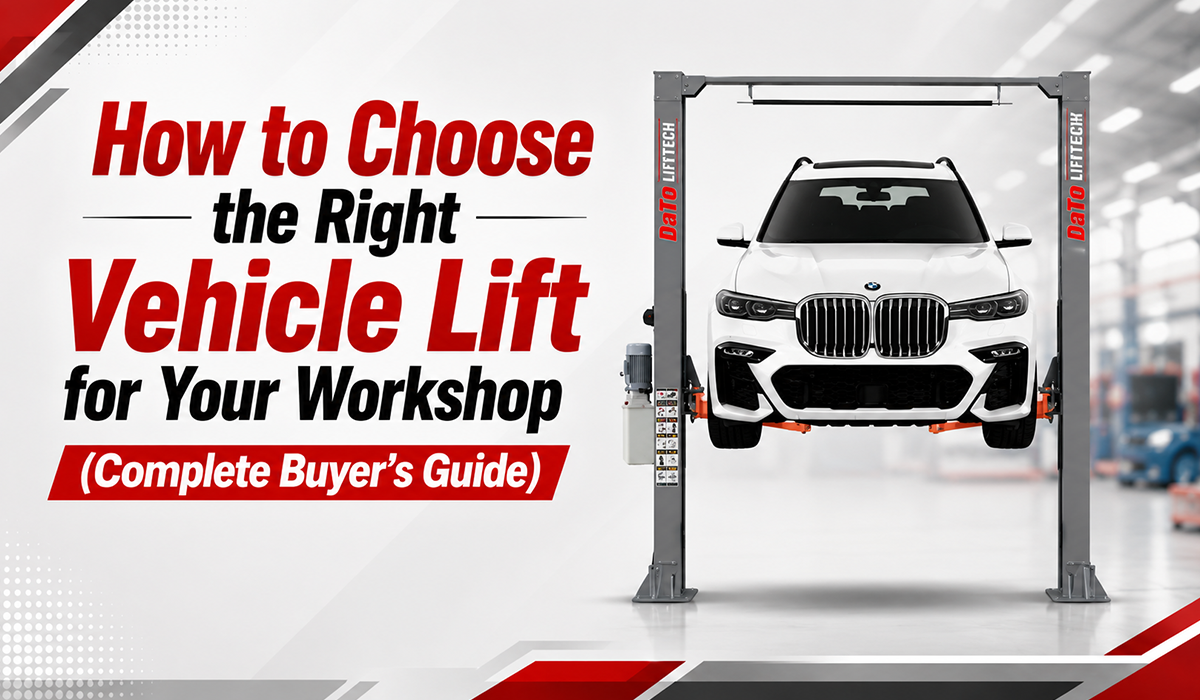
Choosing the right vehicle lift for workshop operations is an important decision that can affect technician productivity, workshop space, vehicle compatibility, and workplace safety. A lift is used for much more than simply raising a vehicle. It provides access to brakes, suspension, exhaust systems, underbody components, wheels, and other areas that are difficult to reach at ground level.
For UAE workshops, the decision requires additional consideration because facilities may service a wide range of passenger cars, SUVs, pickups, and commercial vehicles. This car lift buying guide explains what workshop owners should evaluate before selecting garage lifting equipment, from vehicle requirements and available space to lifting capacity, safety, and long-term maintenance.
Understand Your Workshop’s Vehicle Requirements
The right lift should be selected according to the vehicles you expect to handle regularly. A workshop that mainly services compact passenger cars will have different requirements from a facility working with large SUVs, pickups, or light commercial vehicles.
Start by reviewing the typical weight, wheelbase, height, ground clearance, and lifting points of the vehicles entering your workshop. The manufacturer’s rated capacity should always exceed the requirements of the vehicles being serviced.
It is also useful to consider future requirements. If your workshop expects to expand into SUV, pickup, or commercial vehicle servicing, selecting equipment with suitable capacity and dimensions from the beginning can prevent the need for an early replacement.
Know the Different Vehicle Hoist Types
There is no single lift design that suits every workshop. Vehicle hoist types differ in their construction, footprint, lifting method, and accessibility.
Two-post lifts are commonly considered for general mechanical servicing because they can provide good access to wheels and underbody components while using relatively little floor space. Four-post lifts support vehicles along runways and can be useful when stability, larger vehicles, or certain alignment-related applications are important.
Scissor lifts use a platform-based mechanism and can be practical where workshop space or bay flexibility is a concern. However, the platform design may affect access to certain areas underneath the vehicle. The important point is not to choose a lift simply because it is popular. The design should correspond with the type of repairs your technicians perform and the vehicles your workshop handles.
What UAE Workshops Should Consider
The UAE automotive service market includes a broad mix of vehicles, from compact cars and luxury models to large SUVs, pickups, and commercial vehicles. Workshop owners therefore need equipment that reflects the actual local customer base rather than selecting a lift based purely on price.
The operating environment also makes reliability and proper maintenance important. Workshops should consider whether technical support, replacement parts, servicing, and installation assistance are readily available.
Future vehicle trends should also be considered. As hybrid and electric vehicles become more common, workshops may need to accommodate different vehicle weights, battery configurations, and manufacturer-specific lifting requirements. Investing with future servicing needs in mind can make automotive lifts UAE workshops use more adaptable over time.
Measure Your Workshop Before Buying
Available space is one of the most commonly overlooked considerations when choosing a vehicle lift for workshop use.
Before selecting a model, measure:
- Available floor space
- Ceiling height
- Bay width and length
- Vehicle entry and exit clearance
- Space around the raised vehicle
- Floor condition and construction
The lift itself is only part of the space requirement. Technicians also need enough room to move tools, equipment, and parts around the vehicle. Ceiling height is particularly important. A lift may have sufficient lifting capacity but still be unsuitable if raising taller SUVs or vans causes the vehicle to approach the ceiling or other overhead structures.
Safety and Installation Matters Most
A vehicle lift must provide stable support throughout raising, servicing, and lowering operations. Safety features such as mechanical locking systems, suitable lifting adapters, overload protection, and controlled lowering mechanisms should be evaluated before purchase.
Installation requirements also deserve careful attention. The workshop floor must meet the manufacturer’s specifications, and the lift should be installed according to the approved procedures. Electrical, hydraulic, anchoring, and clearance requirements can vary depending on the equipment. Regular inspection and maintenance are equally important. A lift is a working machine, and its components should be checked and maintained according to the manufacturer’s recommendations.
Common Mistakes to Avoid
Do not choose a lift based only on price. A lower initial cost may not represent better value if the equipment does not suit your vehicles or workload.
Do not ignore workshop dimensions. Ceiling height, floor space, and vehicle movement should be confirmed before purchase.
Do not overlook future requirements. Consider whether the workshop may service heavier vehicles, SUVs, pickups, or newer powertrain technologies.
Do not compromise on installation and safety. Proper installation, rated capacity, locking systems, and routine maintenance are essential parts of responsible lift selection.
Frequently Asked Questions
What is the best vehicle lift for a workshop?
The best lift depends on the vehicles serviced, available workshop space, repair applications, and required lifting capacity. There is no single design suitable for every workshop.
How much lifting capacity does a workshop lift need?
The capacity should be appropriate for the heaviest vehicles the workshop intends to service, with the manufacturer’s rated limit always respected. Consider future vehicle requirements rather than only the current workload.
Which vehicle hoist type is best for general repairs?
Two-post lifts are commonly suitable for many general mechanical applications, while four-post and scissor designs can be better suited to specific space, stability, alignment, or service requirements.
Final Thoughts
Choosing a vehicle lift for workshop operations requires a balance between vehicle compatibility, workshop space, lifting capacity, repair requirements, safety, and future needs. Rather than selecting equipment based on one specification, workshop owners should evaluate how the lift will fit into their complete working environment.
For UAE workshops, the right combination of automotive lifts in the UAE, garage lifting equipment, and other automotive service tools can support safer vehicle servicing and a more efficient workshop workflow. A carefully planned investment can also provide greater flexibility as vehicle types and servicing requirements continue to change. For product information or expert guidance on vehicle lifts and workshop equipment, contact DaTo at +971 800 3286 or email info@dato.ae.